OUR CAPABILITIES
Our team provides a full suite of bespoke Private Wealth Management resources to address the complex needs of wealthy clients and their families.
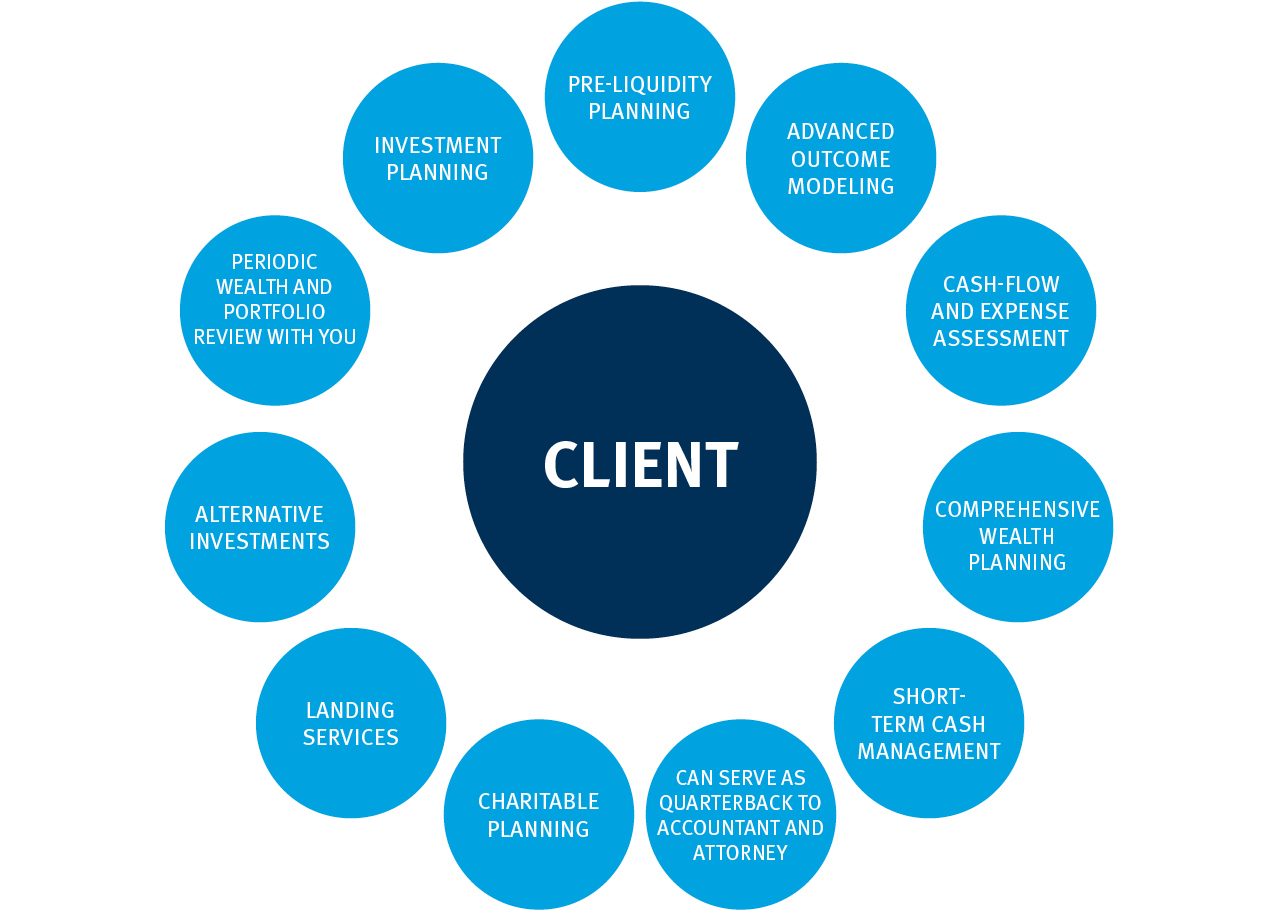
Harnessing the Breadth of Stifel’s Resources
Key Points
- Hall Wealth Advisory Group provides integrated strategies including wealth management, estate and tax planning, insurance, and investment planning
- Focused on specific needs of client without a “one-size-fits-all” approach
- Meet client where they are on the lifecycle and evolve with them
- Provide fee-based services through our advisory platform and serve clients who prefer to remain transactional through brokerage services
- Fundamentally address the purpose and end-game of your wealth beyond just the proceed amount
Our Investment Process
 |
 |
 |
 |
 |
| In-depth conversation with your wealth management team | Plan an asset allocation strategy that meets your stated objectives | Identify best-in-class managers and strategies best suited for you | Help you build and phase-in the investment portfolio, asset by asset | Periodically review investments and performance with you, adjusting as needed to align with objectives |
| Investment Advisory Services Available Through Stifel | Discretionary/Nondiscretionary Programs via Stifel's Advisory Services | Manager and Fund Selection | Asset Allocation | Separately Managed Accounts |
|
|
|
|
|
Financial Lifecycle Planning
 |
 |
 |
 |
| EARLY ADULTHOOD / CAREER | FAMILY AND WEALTH PLANNING | PEAK EARNING AND INVESTING YEARS | RETIREMENT |
|
|
|
|
| ESTATE PLANNING STRATEGIES | INSURANCE | INVESTMENT PLANNING | CORPORATE EXECUTIVE SERVICES |
|
|
|
|
Stifel does not provide legal or tax advice. You should consult with your legal and tax advisors regarding your particular situation.
Stifel Donor-Advised Funds are handled by Stifel Charitable Inc., which is a 501(c)(3) non-profit organization. Stifel Financial Corp. companies, including Stifel, Nicolaus & Company, Incorporated, Stifel Bank, and Stifel Trust Company, N.A., provide services to Stifel Charitable Inc. Stifel does not provide legal or tax advice. You should consult with your legal and tax advisors regarding your particular situation.
Stifel’s banking and lending services are provided by Stifel Bank and Stifel Bank & Trust (collectively Stifel Banks). Trust and fiduciary services are provided by Stifel Trust Company, N.A. and Stifel Trust Company Delaware, N.A. (collectively Stifel Trust Companies).
Stifel Bank, Member FDIC, Equal Housing Lender, NMLS# 451163, is affiliated with Stifel Bank & Trust, Member FDIC, Equal Housing Lender, NMLS# 375103, Stifel Trust Company, N.A., and Stifel Trust Company Delaware, N.A. All are wholly owned subsidiaries of Stifel Financial Corp. and affiliates of Stifel, Nicolaus & Company, Incorporated, Member SIPC & NYSE. Unless otherwise specified, references to Stifel may mean Stifel Financial Corp. and/or any of its subsidiaries. Unless otherwise specified, products purchased from or held by Stifel are not insured by the FDIC, are not deposits or other obligations of Stifel Banks or Stifel Trust Companies, are not guaranteed by Stifel Banks and Stifel Trust Companies, and are subject to investment risk, including possible loss of the principal. Stifel Banks and Stifel Trust Companies do not provide legal or tax advice.
Alternative investments involve a high degree of risk, often engage in leveraging and other speculative investment practices that may increase the risk of investment loss, can be highly illiquid, are not required to provide periodic pricing or valuation information to investors, may involve complex tax structures and delays in distributing tax information, are not subject to the same regulatory requirements as more traditional investments, and often charge high fees, which may erode performance. An investment is appropriate only for investors who have the capacity to absorb a loss of some or all of their investment.
A minimum investment applies within the various investment advisory programs. There are other costs associated with these programs, including but not limited to: execution costs for trades effected with other broker-dealers, exchange fees, transfer or other taxes, interest expense, any third-party account or administrative fees, wire transfer fees, any internal expenses charged by mutual funds or other investment companies, and the costs associated with products and services not described in the applicable Advisory Agreement. Ask a Stifel Financial Advisor for the Advisory Disclosure Brochure, which further outlines the fees, services, exclusions, and disclosures associated with these programs. Investors should consider all terms and conditions before deciding whether fee-based investing is appropriate for their needs.
Portfolios invest in a wide variety of securities and use a variety of strategies to pursue the objective. You should carefully review all of the portfolio-related materials that are available to you for a full understanding of the strategy and related risks. Investing involves risk, including the possible loss of principal.
Asset allocation and diversification do not ensure a profit or protect against loss.
Exchange traded funds (ETFs) are subject to market risk, including the possible loss of principal, and may trade for less than their net asset value. ETFs trade like a stock, and there will be brokerage commissions associated with buying and selling exchange traded funds unless trading occurs in a fee-based account. Investors should consider an ETF’s investment objective, risks, charges, and expenses carefully before investing. The prospectus, which contains this and other important information, is available from your Financial Advisor and should be read carefully before investing.
Investors should carefully compare fees and expenses when considering exchanging an existing life insurance policy for a new one. Significant charges may apply when surrendering an existing policy and a new surrender period will begin when a new policy is purchased.
Variable contracts are offered by prospectus only. Investors should consider the investment objective, risks, charges, and expenses carefully before investing. The prospectus, which contains this and other important information, is available from your Financial Advisor and should be read carefully before investing. The cash value of permanent insurance grows tax-deferred, and withdrawals — up to the cost basis — may be taken free of income tax. However, withdrawals will reduce the account value and the death benefit, and with certain policies, withdrawals prior to age 59 1/2 may be subject to a 10% federal tax penalty. Due to the variable sub-accounts, the insured is accepting additional risk in the variable life contract.
Investors should obtain a prospectus for an annuity’s contract and the underlying subaccounts and consider the investment objective, risks, charges, and expenses carefully before investing. The prospectus, which contains this and other important information, is available from your Financial Advisor and should be read carefully before investing. Taxes will be due upon withdrawal, and distributions prior to age 59 1/2 may be subject to a 10% penalty. Variable annuities are not insured by the FDIC or any government agency and involve market risk, including the possible loss of principal. Variable annuities are suitable for long-term investment and entail fees, such as mortality and expense charges and optional benefit rider charges. Guarantees are based on the claims-paying ability of the issuing insurance company.